
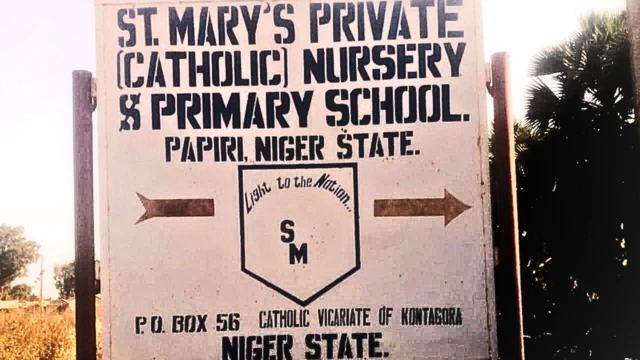
- Nigeria mass kidnapping leaves over 300 students and staff in captivity.
- Families in Niger State living in fear, grief and uncertainty.
- NSA assures parents that kidnapped children are alive and safe.
- Hope rises as negotiations for release continue quietly.
Nigeria has once again been shaken by a mass kidnapping, one of the worst in recent years, leaving hundreds of families trapped between fear and hope as they await the return of more than 300 schoolchildren abducted from St. Mary’s Catholic School in Papiri, Niger State. The incident adds to a growing pattern of school abductions across northern Nigeria, attacks that have become a painful reality for communities struggling with insecurity.
READ ALSO: Akpabio Sues Natasha for ₦200b Over Sexual-Harassment Claims
ATTENTION: Click “HERE” to join our WhatsApp group and receive News updates directly on your WhatsApp!
For two long weeks, Samaila Livinus has swallowed his pain like a stone in his chest. His five-year-old son, the youngest of the abducted pupils is still missing. At home, silence has become louder than words. His nine-year-old child asks questions he cannot answer, while the three-year-old stands at the door waiting for a brother who has not returned.
“You try not to cry,” he said softly, hands clasped tightly as if holding himself together. “Sometimes, you just have to be strong for everyone.”
His wife barely eats. Visitors come daily with prayers, comfort, sometimes only long hugs. But the house remains heavy with a grief nobody can name.
More than 300 boarding students, teachers and staff were rounded up when armed men invaded St. Mary’s Catholic School — one of the largest mass kidnappings in Nigeria in recent memory. About 50 managed to escape, running barefoot through the night, but 265 remain in captivity, according to school officials.
Security sources revealed that negotiators have established contact with the kidnappers, and the children’s location is known, a small strand of hope in a storm of uncertainty.
Livinus tries to stay optimistic, though the fear never leaves. He still imagines his son clutching his school bag, smiling, tugging his shirt on the first day of term. Now he wonders whether the boy has eaten, slept, or received medicine because the child had been ill before the abduction.
“If this was death, we would know how to grieve,” he murmured. “But this kind of waiting… you don’t know what the child is going through, and you cannot help. That is the worst pain.”
Another parent, one whose two children were taken could not bear the strain. He died of cardiac complications only days after the attack. The shock has broken the strongest men.
This week, a small beam of relief arrived when National Security Adviser Nuhu Ribadu visited Kontagora, meeting church leaders and school authorities. He assured them the children were alive.
“Nuhu Ribadu came and renewed our hope,” Livinus said slowly, emotion in his voice. “He told us the federal government will do something and we are holding on to that.”
The bishop of Kontagora Diocese, Bulus Dauwa Yohanna, who oversees the school, echoed the same fragile, rising optimism.
“He came and assured us that the children are safe,” the bishop said. “We believe they will come back. It can happen anytime.
It was the first night he had slept in days.
Across the country, panic led the Ministry of Education to order the immediate closure of 47 boarding schools, fearing further attacks. In Abuja, students packed bags and left their hostels with frightened parents rushing them into waiting vehicles.
READ ALSO: Tonye Cole Sues FCT Minister Wike, Channels TV for N40 Billion Defamation
Despite global calls for intervention, this tragedy comes at a tense moment, following US President Donald Trump’s dramatic warning of military action in Nigeria to protect Christians from extremist attacks, a statement that has sparked heated reactions across geopolitical lines.
But for now, politics is far from the minds of parents like Livinus. Their world has shrunk to one prayer, one cry, one hope.
“We are hopeful,” he said again, almost like a chant. “We are hopeful.”