- Third Faction Emerges, Deepening Leadership Crisis Within ADC
- Internal Distrust and Legal Battles Undermine Opposition Credibility
- Fragmented Parties Risk Weakening Nigeria’s Multi-Party Democracy Ahead of 2027
Nigeria’s opposition politics continues to slide into deeper uncertainty as the crisis within the African Democratic Congress (ADC) takes a more complex and destabilising turn.
The emergence of a third faction within the party is not merely an internal dispute—it is a reflection of a broader structural fragility confronting opposition platforms as the 2027 general elections draw closer.
ATTENTION: Click “HERE” to join our WhatsApp group and receive News updates directly on your WhatsApp!
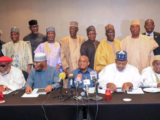
The latest development, driven by a faction aligned with former presidential candidate Dumebi Kachikwu, introduces yet another layer of contestation over legitimacy and leadership. By backing the electoral body’s withdrawal of recognition from the camp associated with David Mark, the group has effectively deepened divisions rather than resolving them.
Its decision to install Kingsley Temitope as interim national chairman underscores the absence of a unified command structure within the party.
This fragmentation raises a critical question: can a party struggling to define its own leadership realistically position itself as a national alternative?
At the centre of the ADC crisis lies a familiar pattern in Nigerian opposition politics—contested authority, competing claims to legitimacy, and reliance on legal and institutional interpretation to settle political disputes.
The proliferation of factions within a single party not only weakens its internal coherence but also diminishes its credibility in the eyes of the electorate.
Unsurprisingly, rival camps have dismissed each other’s actions as opportunistic or externally influenced. While accusations of compromise and political sponsorship continue to circulate, such claims—whether valid or not—highlight a deeper issue: a lack of trust within party structures. Without internal confidence, external competitiveness becomes almost impossible.
Beyond the ADC, this crisis mirrors a wider trend across opposition parties. Internal democracy remains weak, party constitutions are frequently contested, and leadership transitions often trigger instability rather than continuity. These recurring issues point to systemic deficiencies rather than isolated conflicts.
The intervention—or perceived intervention—of institutions such as the electoral body has further complicated matters. While regulatory oversight is essential in a democratic system, its interpretation and application often become contentious when parties are already divided. The ADC’s current standoff illustrates how legal ambiguities can exacerbate political crises rather than resolve them.
Meanwhile, the reaction from the ruling All Progressives Congress (APC) introduces a different dimension to the discourse. The assertion that democracy would remain intact even if major opposition parties fail to appear on the ballot reflects a strict procedural view of electoral politics—one that prioritises compliance with rules over the broader principle of political inclusiveness.
However, this perspective is not without controversy. Critics argue that democracy is not sustained by legality alone but by the presence of credible alternatives. A political system in which opposition parties are weakened—whether by internal failings or external pressures—risks drifting towards dominance by a single political force.
This concern is echoed by voices warning of the long-term implications of a fractured opposition. The absence of a strong and coordinated alternative does not merely affect electoral competition; it alters the balance of power within the democratic system. Without effective opposition, accountability mechanisms weaken, and governance risks becoming less responsive.
The ADC’s situation is particularly instructive because it highlights how internal instability can have external consequences. Legal battles over leadership recognition could ultimately affect the party’s eligibility to participate fully in the electoral process. In such a scenario, the crisis moves beyond internal politics to become a question of democratic representation.
What is unfolding, therefore, is not just a party crisis but a test of Nigeria’s multi-party system. The ability of opposition parties to organise, resolve disputes, and present coherent alternatives will significantly shape the political landscape heading into 2027.
For the ADC and similar parties, the immediate challenge is survival—resolving leadership disputes, restoring organisational order, and rebuilding credibility. But beyond survival lies a more fundamental task: redefining internal governance structures to prevent recurring crises.
Ultimately, the trajectory of Nigeria’s democracy depends not only on the strength of the ruling party but also on the resilience of its opposition. A fragmented opposition weakens electoral competition, reduces policy debate, and risks creating an imbalance that could have lasting consequences.