
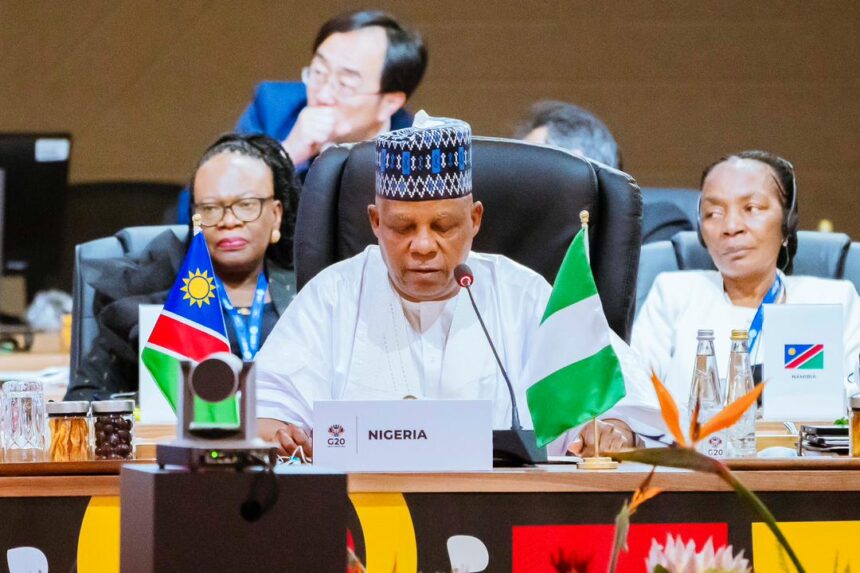
• VP Shettima says Nigeria’s vast agricultural resources make poverty unjustifiable
• Calls for modern farming practices to boost crop yields and economic growth
• Says Nigeria will shape Africa’s future as global growth shifts to the continent
Vice President Kashim Shettima has declared that Nigeria has no justification for widespread poverty, stressing that the country’s abundant and fertile land can drive prosperity if properly developed.
Shettima made the remarks while speaking at the World Economic Forum (WEF) 2026 in Davos, Switzerland, where he highlighted agriculture as a critical pathway to economic transformation.
ATTENTION: Click “HERE” to join our WhatsApp group and receive News updates directly on your WhatsApp!
According to the Vice President, some parts of Nigeria possess such rich soil that wealth creation through agriculture is inevitable if modern methods are applied.
“We have no business being poor. I say this from the bottom of my heart because there are places in Nigeria where the land is so fertile that if you plant money, it will grow,” he said.
READ ALSO: 2027: APC Chieftain Warns Replacing Shettima Could Jeopardise Tinubu’s Reelection
He urged policymakers and citizens to fully embrace modern agricultural techniques, improved fertilisation and innovation to significantly increase productivity across the country.
“All we need to do is to embrace modernity, improved agricultural practices and proper fertilisation,” Shettima added.
The Vice President expressed concern over Nigeria’s low crop yields, particularly in staples such as rice and potatoes, noting that the country lags far behind global benchmarks.
“At present, rice yields are about two to three tonnes per hectare, while some countries produce up to ten tonnes per hectare. The same applies to potatoes. Our output remains largely below global standards,” he said.
Shettima also spoke optimistically about Africa’s economic prospects, describing the continent as the next frontier of global growth, with Nigeria positioned to play a decisive role.
“The trajectory of global growth is tilting towards Africa, and Nigeria will either make or mar that journey,” he stated.
Highlighting Nigeria’s demographic advantage, the Vice President revealed that one in every four Africans is Nigerian, adding that by 2050, Nigeria is projected to become the third most populous country in the world, overtaking the United States.
He stressed that this population growth makes strategic investment in agriculture, development and human capital an urgent national priority.