
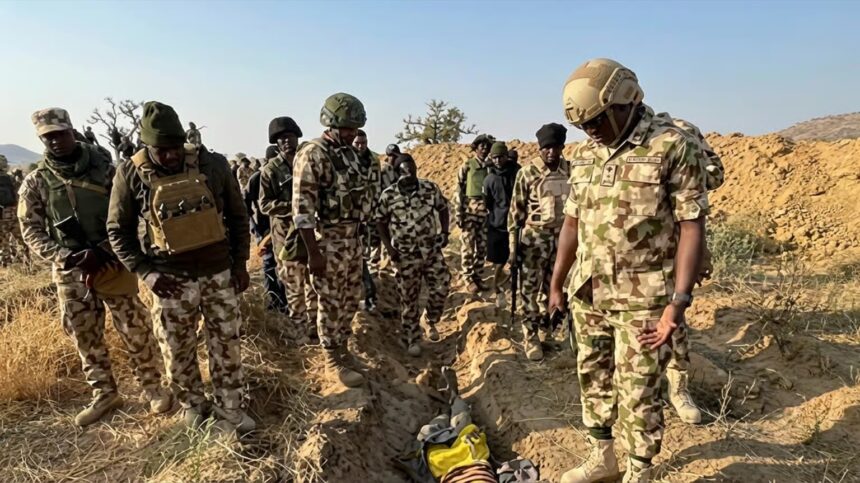
- Troops destroy ISWAP detention camps hidden in Timbuktu Triangle forest
- Over 70 captives escape during military offensive
- 32 ISWAP fighters killed, including senior commanders
- Borno and Yobe operation cripples terrorist ransom network
Troops of Operation Hadin Kai, operating under Operation Desert Sanity V, uncovered the detention facilities after intense ground operations targeting ISWAP strongholds deep inside the Timbuktu Triangle forest.
According to the OPHK spokesperson, Lt.-Col. Sani Uba, preliminary assessments showed that the camps were designed to hold up to 300 detainees, underscoring their importance to ISWAP’s terror, ransom, and control system.
ATTENTION: Click “HERE” to join our WhatsApp group and receive News updates directly on your WhatsApp!
Uba said the sustained pressure from advancing troops directly led to the escape of over 70 captives, many of whom later resurfaced in communities such as Goniri, Buratai and Mandaragirau.
“This was corroborated by many of the escaped captives who later appeared in nearby villages,” Uba said.
One of the escapees, Malam Jidda Ba Jidda, a native of Kufi village near Buratai in Biu Local Government Area, revealed that he fled during a fierce exchange of gunfire between ISWAP fighters and Nigerian troops.
“I escaped during the gun duel between the terrorists and the advancing troops,” he said, adding that he was abducted on December 22, 2025.
During the encounters, OPHK forces inflicted heavy losses on the terrorists. The military confirmed that no fewer than 32 ISWAP fighters were neutralised, including two Qaids and three Munzirs, while several others sustained serious injuries.
Following the clearance of the area, the three detention camps were completely demolished to prevent any future use by the terrorists.
“The operation was conducted successfully and without incident, reflecting the resilience, professionalism, discipline and combat effectiveness of the troops,” Uba stated.
He added that the destruction of the camps goes beyond a battlefield success.
“The destruction of the detention facilities degrades ISWAP’s internal enforcement system, disrupts their ransom operations, and further restricts their freedom of action,” he said.
Uba noted that the mass escape of detainees not only weakens ISWAP financially but also opens new intelligence opportunities, as survivors can provide valuable information to support ongoing counter-insurgency efforts.
The operation, he said, marks a major breakthrough into territories previously considered inaccessible and highlights the growing effectiveness of Nigeria’s counter-terrorism campaign in the North-East