
-
Cabinet dissolution sparks uncertainty: Former appointees in Anambra State are unsure of retention, redeployment or exit following Governor Soludo’s second-term reset.
-
Political dynamics have shifted: Reduced influence of support groups and evolving power structures may reshape how new appointments are made.
-
Lobbying intensifies amid high stakes: Competing interests — performance, loyalty and political reward — are driving quiet manoeuvres ahead of the new cabinet list.
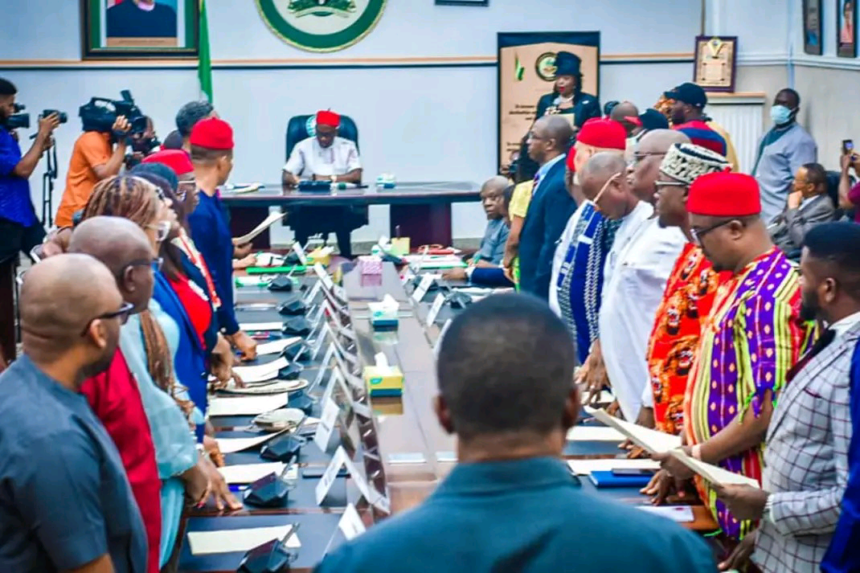
The political landscape in Anambra State has been thrown into a mix of suspense, quiet calculations and behind-the-scenes lobbying following Governor Chukwuma Charles Soludo’s sweeping dissolution of his first-term Executive Council.
This is a routine move that has nonetheless sparked intense uncertainty over the fate of former commissioners and political aides.
ATTENTION: Click “HERE” to join our WhatsApp group and receive News updates directly on your WhatsApp!
The governor, who was sworn in for a second term earlier in the week, directed all political appointees to immediately hand over to Permanent Secretaries or the most senior civil servants across Ministries, Departments and Agencies.
While such dissolutions typically signal administrative transition, the current development has triggered heightened speculation due to shifting political dynamics and evolving power structures within the state.
A Routine Move, An Unusual Tension
Ordinarily, the dissolution of a cabinet at the start of a new tenure is seen as procedural.
However, insiders describe the present situation as “unusually tense,” with many former appointees uncertain about whether they will be retained, reassigned or completely excluded from the incoming cabinet.
Political observers note that the outgoing team delivered mixed results. While some commissioners earned public praise for visible impact and accessibility, others faced criticism for underperformance or detachment from grassroots realities.
“The truth is that performance alone does not determine reappointment in Nigerian politics.
“There are political debts, loyalty considerations and strategic balancing that always come into play,” a senior party stakeholder told our correspondent.
READ ALSO: Soludo sacks political appointees, orders immediate handover
Changing Political Calculations
One of the defining features of Soludo’s first-term cabinet was its diverse composition, with many appointees emerging through support groups, political mobilisation structures and stakeholder recommendations during the 2021 governorship election.
However, that pathway appears to have shifted significantly ahead of the 2025 re-election campaign.
Unlike the previous cycle, open mobilisation by support groups was considerably reduced — a development some insiders attribute to a deliberate strategy by the governor to streamline political engagements and minimise external pressures.
“This time around, the governor ran a more controlled political process,” another source said. “That means the old structures that produced some appointees may no longer carry the same weight.”
This shift has deepened uncertainty, particularly among those who rode into government on the back of those now-diminished structures.
Loyalty, Performance and Political Reward
As the governor prepares to assemble a new cabinet, competing interests are already emerging. Party loyalists and stakeholders who contributed to his re-election are believed to be expecting compensation through appointments.
At the same time, technocrats and high-performing officials from the outgoing administration may be considered for retention to ensure continuity in governance.
A political analyst in Awka explained, “Government is about balancing continuity with fresh energy.
“You cannot discard experience entirely, especially when major projects are ongoing.
There are also indications that some former appointees may be redeployed into different roles where their expertise could be better utilised, while others may quietly exit public service.
Quiet Lobbying and Rising Expectations
Across Awka and other parts of Anambra State, subtle lobbying efforts are reportedly intensifying, with political actors seeking endorsements, leveraging relationships and positioning themselves for possible appointments.
The situation has also revived conversations around the nature of public office and the transient nature of political power.
Interestingly, public reactions have been mixed. While some outgoing officials are being commended for their service, others are facing renewed criticism, particularly over perceived inaccessibility while in office.
“In many cases, people complain that leaders become distant once they assume power,” a community leader said. “But immediately they leave office, they become accessible again. It’s a cycle Nigerians are familiar with.”
The ‘Gear-4’ Promise and What Lies Ahead
Governor Chukwuma Charles Soludo had, during his inauguration, assured residents that his second term would operate at a higher level of performance, which he described as shifting into “Gear-4.”
With ongoing projects spanning infrastructure, economic reforms, security and public sector modernisation, the composition of the next cabinet is expected to play a decisive role in determining the trajectory of the administration.
For many observers, the key question remains whether the governor will prioritise continuity, reward loyalty, or inject entirely new faces into his government.
Until the new cabinet is unveiled, the fate of dozens of former commissioners, advisers and aides will remain uncertain — suspended between expectation, speculation and political reality.